🔩 Industrial Revolution Metals
Fe — Iron (26)
Discovery: Known since antiquity (meteoric iron by ~3000 BCE). Smelted iron replaced bronze, launching the Iron Age (~1200 BCE).
World-Changing Impact:
Key Fact: Iron makes up ~35% of Earth's total mass, mostly in the core.
World-Changing Impact:
- Iron is the backbone of civilization's infrastructure
- Steel (iron + carbon) enabled railways, skyscrapers, bridges, and ships
- The Bessemer Process (1856) made mass steel production possible, fueling the Industrial Revolution
- Modern world uses ~1.8 billion tonnes of steel annually
Key Fact: Iron makes up ~35% of Earth's total mass, mostly in the core.
Cu — Copper (29)
Discovery: ~9000 BCE in the Middle East — one of the first metals used by humans.
World-Changing Impact:
Key Fact: The Statue of Liberty contains 80 tonnes of copper sheeting.
World-Changing Impact:
- Alloyed with tin to create bronze, launching the Bronze Age (~3300 BCE)
- Essential for electrical wiring — copper conducts electricity better than any affordable metal
- Enabled the telegraph, telephone, and electrification of cities
- Modern uses: electronics, plumbing, renewable energy systems
Key Fact: The Statue of Liberty contains 80 tonnes of copper sheeting.
Al — Aluminum (13)
Discovery: Isolated by Hans Christian Ørsted in 1825. Once more expensive than gold!
World-Changing Impact:
Key Fact: Napoleon III served state dinners on aluminum plates while lesser guests ate from gold.
World-Changing Impact:
- The Hall-Héroult process (1886) made aluminum cheap and abundant
- Lightweight strength revolutionized aviation — from Wright Flyer engines to modern jets
- Enabled lightweight vehicles, beverage cans, power lines, and spacecraft
- Third most abundant element in Earth's crust
Key Fact: Napoleon III served state dinners on aluminum plates while lesser guests ate from gold.
C — Carbon (6)
Discovery: Known since antiquity as charcoal, diamond, and graphite.
World-Changing Impact:
Key Fact: Carbon forms more compounds than all other elements combined.
World-Changing Impact:
- Coal (carbon) powered the entire Industrial Revolution — steam engines, factories, railways
- Steel is iron alloyed with carbon
- Organic chemistry — carbon is the basis of ALL life on Earth
- Modern: carbon fiber composites, graphene, carbon nanotubes
- Fossil fuels (hydrocarbons) still supply ~80% of world energy
Key Fact: Carbon forms more compounds than all other elements combined.
Sn — Tin (50)
Discovery: Known since ~3500 BCE. Critical alloying metal of the ancient world.
World-Changing Impact:
Key Fact: Control of tin sources was a strategic military priority for millennia.
World-Changing Impact:
- Alloyed with copper to create bronze — harder, more durable tools and weapons
- Tin trade routes shaped ancient Mediterranean geopolitics (Cornwall to Phoenicia)
- Tin plating preserved food in cans, revolutionizing nutrition and military logistics
- Modern: solder in electronics, tin oxide coatings on glass
Key Fact: Control of tin sources was a strategic military priority for millennia.
🔗 The Steel Trinity
Iron + Carbon + Heat = Steel
The Bessemer Process (1856) and later the open-hearth furnace transformed civilization. Steel production is still the single best indicator of a nation's industrial capacity.
Iron + Carbon + Heat = Steel
The Bessemer Process (1856) and later the open-hearth furnace transformed civilization. Steel production is still the single best indicator of a nation's industrial capacity.
📊 By the Numbers
- Global steel production: 1.88 billion tonnes/year
- Copper in an average US home: ~200 kg
- Aluminum cans recycled/year: ~45 billion (US alone)
- Carbon in human body: ~18.5% by mass
☢️ Nuclear Age Elements
U — Uranium (92)
Discovery: Martin Klaproth, 1789. Named after the planet Uranus.
World-Changing Impact:
Key Fact: 1 kg of U-235 releases energy equivalent to ~2,700 tonnes of coal.
World-Changing Impact:
- Becquerel discovered radioactivity in uranium (1896), opening nuclear physics
- Manhattan Project: U-235 fission powered the Little Boy bomb dropped on Hiroshima (1945)
- Nuclear power plants generate ~10% of world electricity — carbon-free
- Uranium enrichment remains central to geopolitics and nonproliferation treaties
Key Fact: 1 kg of U-235 releases energy equivalent to ~2,700 tonnes of coal.
Pu — Plutonium (94)
Discovery: Glenn Seaborg et al., 1940 at UC Berkeley. First synthesized element used in weapons.
World-Changing Impact:
Key Fact: Only ~8 kg of Pu-239 is needed for a nuclear weapon — a sphere the size of a grapefruit.
World-Changing Impact:
- Pu-239 powered the Fat Man bomb dropped on Nagasaki (1945)
- Used in breeder reactors — can generate more fissile material than it consumes
- Powers deep-space probes (RTGs): Voyager, Curiosity rover, New Horizons
- Highly toxic if inhaled — even micrograms in the lungs raise cancer risk
Key Fact: Only ~8 kg of Pu-239 is needed for a nuclear weapon — a sphere the size of a grapefruit.
Ra — Radium (88)
Discovery: Marie & Pierre Curie, 1898. Isolated from pitchblende ore through grueling labor.
World-Changing Impact:
Key Fact: Curie's notebooks are still so radioactive they're kept in lead-lined boxes.
World-Changing Impact:
- Proved that atoms are not indivisible — launched the nuclear age
- Marie Curie: first woman Nobel laureate, only person with Nobels in two sciences
- Early medical use: cancer radiotherapy ("Curietherapy")
- Cautionary tale: radium paint workers ("Radium Girls") revealed radiation dangers
Key Fact: Curie's notebooks are still so radioactive they're kept in lead-lined boxes.
H — Hydrogen (1)
Discovery: Henry Cavendish, 1766. Named by Lavoisier ("water-former").
World-Changing Impact:
Key Fact: The Haber-Bosch process is called the most important invention of the 20th century.
World-Changing Impact:
- Most abundant element in the universe (~75% of all baryonic matter)
- Hydrogen fusion powers every star, including our Sun
- H-bomb (thermonuclear weapon): up to 1000× or more the power of the first fission bombs
- Haber-Bosch process: H₂ + N₂ → NH₃ (ammonia) — feeds ~half the world's population
- Future: hydrogen fuel cells for clean energy and transportation
Key Fact: The Haber-Bosch process is called the most important invention of the 20th century.
⚡ Chain Reaction Timeline
- 1896 — Becquerel discovers radioactivity
- 1898 — Curies discover radium & polonium
- 1938 — Hahn & Strassmann achieve fission
- 1942 — Fermi's Chicago Pile-1: first controlled chain reaction
- 1945 — Trinity test, Hiroshima, Nagasaki
- 1954 — First nuclear power plant (Obninsk, USSR)
🌍 Geopolitical Impact
Nuclear weapons created the doctrine of Mutually Assured Destruction (MAD), paradoxically preventing direct conflict between superpowers. The Nuclear Non-Proliferation Treaty (1968) remains the cornerstone of international arms control. Nine nations currently possess nuclear weapons.
Nuclear weapons created the doctrine of Mutually Assured Destruction (MAD), paradoxically preventing direct conflict between superpowers. The Nuclear Non-Proliferation Treaty (1968) remains the cornerstone of international arms control. Nine nations currently possess nuclear weapons.
💡 Electronics & Modern Technology
Si — Silicon (14)
Discovery: Jöns Jacob Berzelius, 1824. Second most abundant element in Earth's crust.
World-Changing Impact:
Key Fact: A modern chip contains ~50 billion transistors on a piece of silicon smaller than a fingernail.
World-Changing Impact:
- Semiconductor properties make silicon the foundation of ALL modern electronics
- Silicon chips power computers, smartphones, internet infrastructure
- "Silicon Valley" named for the element that built the tech industry
- Solar panels: crystalline silicon converts sunlight to electricity
- Moore's Law: transistor density doubles ~every 2 years
Key Fact: A modern chip contains ~50 billion transistors on a piece of silicon smaller than a fingernail.
Li — Lithium (3)
Discovery: Johan August Arfwedson, 1817. Lightest metal, lightest solid element.
World-Changing Impact:
Key Fact: Global lithium demand is projected to increase 40× by 2040.
World-Changing Impact:
- Lithium-ion batteries power smartphones, laptops, electric vehicles, and grid storage
- Enabling the electric vehicle revolution (Tesla, BYD, etc.)
- Critical for renewable energy storage (solar + wind → lithium batteries)
- Psychiatric medicine: lithium salts treat bipolar disorder since 1949
- "White gold" — lithium mining is reshaping geopolitics (Chile, Australia, Congo)
Key Fact: Global lithium demand is projected to increase 40× by 2040.
Au — Gold (79)
Discovery: Known since ~4000 BCE. Prized for beauty, rarity, and resistance to corrosion.
World-Changing Impact:
Key Fact: All gold ever mined would fill about 4.5 Olympic swimming pools.
World-Changing Impact:
- Basis of monetary systems for millennia — the Gold Standard backed currencies until 1971
- Drove exploration: Spanish conquest of the Americas, California Gold Rush (1849)
- Modern electronics: gold's conductivity and corrosion resistance make it essential in connectors, circuit boards, and satellites
- Nanotechnology: gold nanoparticles used in medical diagnostics and cancer treatment
Key Fact: All gold ever mined would fill about 4.5 Olympic swimming pools.
Ge — Germanium (32)
Discovery: Clemens Winkler, 1886. Predicted by Mendeleev as "eka-silicon" — a triumph for the periodic table.
World-Changing Impact:
Key Fact: The first transistor used germanium, not silicon. Silicon only dominated from the 1960s onward.
World-Changing Impact:
- First semiconductor used in transistors (1947 Bell Labs)
- Enabled the electronics revolution before silicon took over
- Still used in fiber optics, infrared optics, and specialized electronics
- Validated Mendeleev's periodic law — predicted properties matched almost perfectly
Key Fact: The first transistor used germanium, not silicon. Silicon only dominated from the 1960s onward.
W — Tungsten (74)
Discovery: Fausto & Juan José Elhuyar, 1783. Highest melting point of all elements (3422°C).
World-Changing Impact:
Key Fact: Symbol 'W' comes from German Wolfram — named after wolframite ore.
World-Changing Impact:
- Tungsten filaments (1904; ductile wire from 1910) made incandescent bulbs bright and long-lasting
- Tungsten carbide: extremely hard material for cutting tools, drill bits, mining equipment
- Armor-piercing ammunition and radiation shielding
- Critical in high-temperature aerospace and industrial applications
Key Fact: Symbol 'W' comes from German Wolfram — named after wolframite ore.
🔋 The Battery Revolution
Lithium-ion batteries (commercialized by Sony, 1991) have the highest energy density of any rechargeable battery. John Goodenough, Stanley Whittingham, and Akira Yoshino won the 2019 Nobel Prize in Chemistry for their development.
Lithium-ion batteries (commercialized by Sony, 1991) have the highest energy density of any rechargeable battery. John Goodenough, Stanley Whittingham, and Akira Yoshino won the 2019 Nobel Prize in Chemistry for their development.
📱 Elements in Your Phone
A single smartphone contains ~30 different elements!
- Silicon — processor chips
- Lithium — battery
- Gold — circuit connectors
- Copper — wiring
- Tantalum — capacitors
- Indium — touchscreen
- Rare Earths — speakers, vibration motor
A single smartphone contains ~30 different elements!
🧬 Medicine & Biology
O — Oxygen (8)
Discovery: Joseph Priestley & Carl Scheele, 1774. Named by Lavoisier ("acid-former").
World-Changing Impact:
Key Fact: Oxygen is produced by photosynthesis — cyanobacteria oxygenated Earth's atmosphere 2.4 billion years ago.
World-Changing Impact:
- Constitutes 21% of atmosphere — essential for aerobic life
- Medical oxygen therapy saves millions of lives annually (surgery, respiratory care, COVID-19)
- Combustion: oxygen enables fire, engines, rockets, and industrial processes
- Ozone (O₃) layer protects life from UV radiation
- Liquid oxygen (LOX) is a primary rocket propellant
Key Fact: Oxygen is produced by photosynthesis — cyanobacteria oxygenated Earth's atmosphere 2.4 billion years ago.
N — Nitrogen (7)
Discovery: Daniel Rutherford, 1772. Makes up 78% of Earth's atmosphere.
World-Changing Impact:
Key Fact: Fritz Haber won the Nobel Prize but also developed chemical weapons — one of history's most morally complex scientists.
World-Changing Impact:
- Haber-Bosch process (1913): converts N₂ → ammonia → fertilizer. Feeds ~4 billion people
- Without synthetic nitrogen fertilizer, half the world's population could not exist
- Nitrogen compounds: explosives (TNT, nitroglycerin), propellants, dyes
- Liquid nitrogen: cryogenics, food preservation, medical procedures
- DNA, proteins, amino acids all contain nitrogen — essential for all life
Key Fact: Fritz Haber won the Nobel Prize but also developed chemical weapons — one of history's most morally complex scientists.
P — Phosphorus (15)
Discovery: Hennig Brand, 1669. Discovered while boiling urine searching for the Philosopher's Stone!
World-Changing Impact:
Key Fact: Brand needed 5,500 liters of urine to produce his first sample of phosphorus.
World-Changing Impact:
- Essential for DNA, RNA, ATP (cellular energy), bones, and teeth
- Phosphate fertilizers are critical for global agriculture
- Match industry: phosphorus friction matches (1830s) transformed fire-starting
- "Phossy jaw" — phosphorus poisoning in match factories drove early labor reforms
- Phosphorus is a finite resource — "peak phosphorus" is a growing concern
Key Fact: Brand needed 5,500 liters of urine to produce his first sample of phosphorus.
I — Iodine (53)
Discovery: Bernard Courtois, 1811. Found in seaweed ash.
World-Changing Impact:
Key Fact: Adding iodine to salt costs ~$0.05 per person per year and raised IQ by about 15 points in the most iodine-deficient US regions.
World-Changing Impact:
- Essential for thyroid hormones — regulates metabolism, brain development
- Iodine deficiency is the leading preventable cause of intellectual disability worldwide
- Iodized salt (introduced 1920s) is one of the most cost-effective public health interventions ever
- Antiseptic: iodine tincture revolutionized wound care and surgery
- Used in medical imaging (contrast agents)
Key Fact: Adding iodine to salt costs ~$0.05 per person per year and raised IQ by about 15 points in the most iodine-deficient US regions.
🏥 Elements That Save Lives Daily
- Oxygen — ventilators, anesthesia
- Iodine — antiseptics, thyroid health
- Chlorine — clean water
- Nitrogen — cryosurgery
- Platinum — chemotherapy (cisplatin)
- Technetium — medical imaging
- Cobalt-60 — radiation therapy
🌾 The Fertilizer Trio: N, P, K
Nitrogen, Phosphorus, and Potassium (NPK) are the three macronutrients in fertilizer. The Haber-Bosch process (N) and phosphate mining (P) are arguably the two most important chemical processes for human survival. Without synthetic fertilizers, Earth could support only ~3-4 billion people.
Nitrogen, Phosphorus, and Potassium (NPK) are the three macronutrients in fertilizer. The Haber-Bosch process (N) and phosphate mining (P) are arguably the two most important chemical processes for human survival. Without synthetic fertilizers, Earth could support only ~3-4 billion people.
💎 Precious & Strategic Elements
Ag — Silver (47)
Discovery: Known since ~5000 BCE. Symbol from Latin argentum.
World-Changing Impact:
Key Fact: Spain extracted so much silver from Potosí (Bolivia) that it caused inflation across Europe and Asia.
World-Changing Impact:
- Basis of coinage for millennia — silver coins drove ancient and medieval trade
- Photography: silver halide chemistry made cameras possible (1839-2000s)
- Best electrical conductor of all elements — used in specialized electronics
- Antimicrobial properties: silver-infused wound dressings, water purification
- Spanish silver from the Americas reshaped the global economy (16th-17th century)
Key Fact: Spain extracted so much silver from Potosí (Bolivia) that it caused inflation across Europe and Asia.
Rare Earth Elements
The 17 Elements: Scandium, Yttrium, and the 15 Lanthanides (La through Lu).
World-Changing Impact:
Key Fact: Despite the name, rare earths aren't rare — they're just difficult and dirty to extract and refine.
World-Changing Impact:
- Neodymium (Nd): Strongest permanent magnets — wind turbines, EV motors, headphones
- Cerium (Ce): Catalytic converters, glass polishing
- Europium (Eu): Red phosphor in displays
- Erbium (Er): Fiber optic amplifiers enabling the internet
- Lanthanum (La): Camera lenses, hybrid car batteries
- China controls ~60% of mining, ~90% of processing — major geopolitical leverage
Key Fact: Despite the name, rare earths aren't rare — they're just difficult and dirty to extract and refine.
⚔️ Resource Wars
Control of strategic elements has driven conflict throughout history:
Control of strategic elements has driven conflict throughout history:
- Gold — Spanish conquest of the Americas
- Tin — Bronze Age trade wars
- Uranium — Cold War arms race
- Rare Earths — modern US-China tensions
- Cobalt — Congo mining exploitation
- Lithium — "white gold" geopolitics
📸 Silver & Photography
Silver halide crystals darken when exposed to light — this simple chemistry made photography possible. From Daguerre's first images (1839) to Kodak film, silver was the foundation of visual culture for 170 years before digital sensors replaced it.
Silver halide crystals darken when exposed to light — this simple chemistry made photography possible. From Daguerre's first images (1839) to Kodak film, silver was the foundation of visual culture for 170 years before digital sensors replaced it.
⚡ Energy & Environment
He — Helium (2)
Discovery: Pierre Janssen & Joseph Lockyer, 1868. First found in the Sun's spectrum before Earth!
World-Changing Impact:
Key Fact: The US once held a strategic helium reserve. We are genuinely running out of helium — it cannot be manufactured.
World-Changing Impact:
- Discovered via spectroscopy of a solar eclipse — first element found off-Earth
- Liquid helium enables superconducting magnets in MRI machines and particle accelerators (LHC)
- Inert gas: welding shield, deep-sea diving mixtures
- Lighter than air: scientific balloons, airships
- Non-renewable on Earth — helium escapes to space once released
Key Fact: The US once held a strategic helium reserve. We are genuinely running out of helium — it cannot be manufactured.
Pb — Lead (82)
Discovery: Known since ~7000 BCE. Symbol from Latin plumbum (hence "plumbing").
World-Changing Impact:
Key Fact: Removing lead from gasoline is estimated to have raised average IQ scores by 2-5 points globally.
World-Changing Impact:
- Roman aqueducts used lead pipes — may have contributed to Rome's decline
- Tetraethyl lead in gasoline (1920s-1990s) boosted engine performance but poisoned generations
- Lead paint caused widespread childhood brain damage before bans
- Lead-acid batteries (1859) — still the most recycled consumer product
- Cautionary element: shows how useful properties can mask devastating health effects
Key Fact: Removing lead from gasoline is estimated to have raised average IQ scores by 2-5 points globally.
Hg — Mercury (80)
Discovery: Known since ~1500 BCE. Only metal liquid at room temperature.
World-Changing Impact:
Key Fact: Mercury's toxicity led to global phase-out via the Minamata Convention (2013).
World-Changing Impact:
- Thermometers (Fahrenheit, 1714) — enabled precise temperature measurement for science and medicine
- Barometers (Torricelli, 1643) — proved atmospheric pressure exists, enabled weather forecasting
- Mercury amalgamation extracted gold and silver from ore for centuries
- Highly toxic: "Mad as a hatter" from mercury poisoning in hat-making
- Minamata disease (1950s Japan) — mercury pollution caused mass neurological damage
Key Fact: Mercury's toxicity led to global phase-out via the Minamata Convention (2013).
🔬 Spectroscopy Revolution
Helium was discovered by analyzing sunlight through a prism. This technique — spectroscopy — became the master key of chemistry, allowing scientists to identify elements by their light signatures. It's how we know the composition of distant stars billions of light-years away.
Helium was discovered by analyzing sunlight through a prism. This technique — spectroscopy — became the master key of chemistry, allowing scientists to identify elements by their light signatures. It's how we know the composition of distant stars billions of light-years away.
🌐 Cross-Cutting Themes & Connections
📅 Timeline of Elemental Discoveries
Ancient World
Before 1000 CE
- Gold (~4000 BCE) — early ornaments
- Copper (~9000 BCE) — tools and weapons
- Tin (~3500 BCE) → Bronze Age
- Iron (~1200 BCE) → Iron Age
- Lead (~7000 BCE) — pipes, weights
- Mercury (~1500 BCE) — alchemy
- Silver (~5000 BCE) — coinage
- Carbon (antiquity) — charcoal, diamonds
- Sulfur (antiquity) — "brimstone"
Age of Chemistry
1660–1860
- Phosphorus (1669) — Brand's urine experiments
- Hydrogen (1766) — Cavendish
- Oxygen (1774) — Priestley & Scheele
- Nitrogen (1772) — Rutherford
- Chlorine (1774) — Scheele
- Aluminum (1825) — Ørsted
- Iodine (1811) — Courtois
- Lithium (1817) — Arfwedson
- Silicon (1824) — Berzelius
Periodic Table Era
1860–1940
- Mendeleev's Table (1869) — predicted undiscovered elements
- Germanium (1886) — confirmed Mendeleev's predictions
- Helium (1868) — found in the Sun first
- Radium (1898) — Curies' breakthrough
- Tungsten filament (1904) — practical light bulbs
- Haber-Bosch (1913) — nitrogen fixation
- Plutonium (1940) — first synthetic weapon element
Modern Age
1940–Present
- Nuclear Age (1945) — uranium & plutonium weapons and power
- Transistor (1947) — germanium, then silicon
- Integrated circuits (1958–59) — germanium, then silicon chips
- Li-ion batteries (1991) — lithium revolution
- Rare earth magnets — wind turbines, EVs
- Graphene (2004) — carbon's wonder form
- CRISPR — biology harnessing elemental chemistry
- Fusion research — hydrogen as ultimate energy source
Mendeleev's Genius
In 1869, Dmitri Mendeleev arranged 63 known elements by atomic weight and noticed periodic patterns in their properties. His genius was leaving gaps for undiscovered elements and predicting their properties.
Predictions confirmed:
The periodic table is arguably the most important organizing framework in all of science.
Predictions confirmed:
- "Eka-aluminum" → Gallium (1875)
- "Eka-boron" → Scandium (1879)
- "Eka-silicon" → Germanium (1886)
The periodic table is arguably the most important organizing framework in all of science.
The Curies' Legacy
Marie Curie (1867–1934) remains the only person to win Nobel Prizes in two different sciences (Physics 1903, Chemistry 1911).
With husband Pierre, she discovered polonium and radium, coined the term "radioactivity," and pioneered mobile X-ray units ("Petites Curies") in WWI that saved countless soldiers' lives.
She died of aplastic anemia caused by years of radiation exposure. Her dedication to science cost her life but opened the nuclear age.
Fritz Haber: Hero & Villain
Fritz Haber's ammonia synthesis (Nobel Prize 1918) may be the most consequential invention of the 20th century — synthetic fertilizer feeds ~4 billion people alive today.
But Haber also developed chlorine gas as a chemical weapon in WWI. His wife Clara, also a chemist, died by suicide days after the first gas attack; many link it to her opposition.
Haber's story is the ultimate embodiment of science's dual-use dilemma: the same knowledge that feeds billions also killed thousands in the trenches.
🔮 The Future: Elements to Watch
💧 Hydrogen Economy
Green hydrogen (produced via electrolysis using renewable energy) could replace fossil fuels in heavy industry, shipping, and aviation. Major investments from EU, Japan, and Saudi Arabia aim to make hydrogen cost-competitive by 2030.
Green hydrogen (produced via electrolysis using renewable energy) could replace fossil fuels in heavy industry, shipping, and aviation. Major investments from EU, Japan, and Saudi Arabia aim to make hydrogen cost-competitive by 2030.
🔋 Post-Lithium Batteries
Sodium-ion, solid-state, and lithium-sulfur batteries are racing to replace current Li-ion tech. Sodium is 1000× more abundant than lithium. The winner could reshape the entire energy storage industry and EV market.
Sodium-ion, solid-state, and lithium-sulfur batteries are racing to replace current Li-ion tech. Sodium is 1000× more abundant than lithium. The winner could reshape the entire energy storage industry and EV market.
🎈 Helium Scarcity
Helium is non-renewable — once released, it escapes Earth's gravity forever. Critical for MRI machines, semiconductor manufacturing, and physics research. Prices have tripled since 2000. No substitute exists for many applications.
Helium is non-renewable — once released, it escapes Earth's gravity forever. Critical for MRI machines, semiconductor manufacturing, and physics research. Prices have tripled since 2000. No substitute exists for many applications.
Next Generation
🧲 Rare Earth Supply Chains
China's dominance in rare earth processing is a strategic vulnerability for Western tech and defense industries. The US, EU, and Australia are investing billions in domestic mining and recycling to reduce dependence.
China's dominance in rare earth processing is a strategic vulnerability for Western tech and defense industries. The US, EU, and Australia are investing billions in domestic mining and recycling to reduce dependence.
Supply Crisis
🧪 Carbon Nanomaterials
Graphene (2D carbon) is 200× stronger than steel, conducts electricity better than copper, and is nearly transparent. Carbon nanotubes could revolutionize computing, materials science, and medicine. The "Carbon Age" may succeed the Silicon Age.
Graphene (2D carbon) is 200× stronger than steel, conducts electricity better than copper, and is nearly transparent. Carbon nanotubes could revolutionize computing, materials science, and medicine. The "Carbon Age" may succeed the Silicon Age.
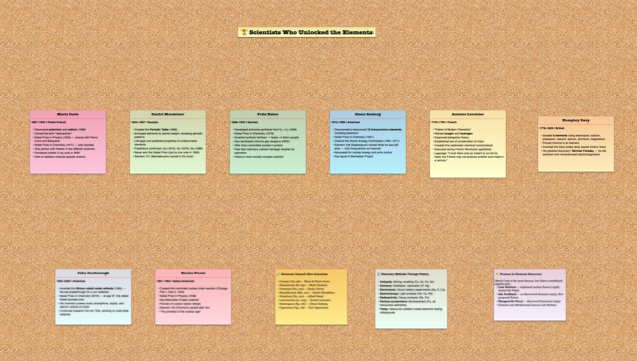
🏆 Nobel Laureates & Key Scientists
⚛️ Elements That Changed the World
A Scientist's Research Board
From the Bronze Age to the Silicon Age, a handful of chemical elements have redirected the course of human civilization. This board maps the elements whose discovery, mastery, and application fundamentally transformed industry, medicine, warfare, technology, and daily life.
From the Bronze Age to the Silicon Age, a handful of chemical elements have redirected the course of human civilization. This board maps the elements whose discovery, mastery, and application fundamentally transformed industry, medicine, warfare, technology, and daily life.
Cl — Chlorine (17)
Discovery: Carl Wilhelm Scheele, 1774. Recognized as element by Humphry Davy, 1810.
World-Changing Impact:
Key Fact: Water chlorination prevents an estimated 33,000+ deaths per year in the US alone.
World-Changing Impact:
- Water chlorination (1908+) virtually eliminated waterborne diseases like cholera and typhoid
- Called the greatest public health advance in history by many epidemiologists
- Bleach and disinfectants: sanitation revolution
- Dark side: chlorine gas was the first lethal gas used on a large scale (WWI, 1915 — Ypres)
- PVC plastics, pharmaceuticals, and industrial chemistry
Key Fact: Water chlorination prevents an estimated 33,000+ deaths per year in the US alone.
Chemical Weapons
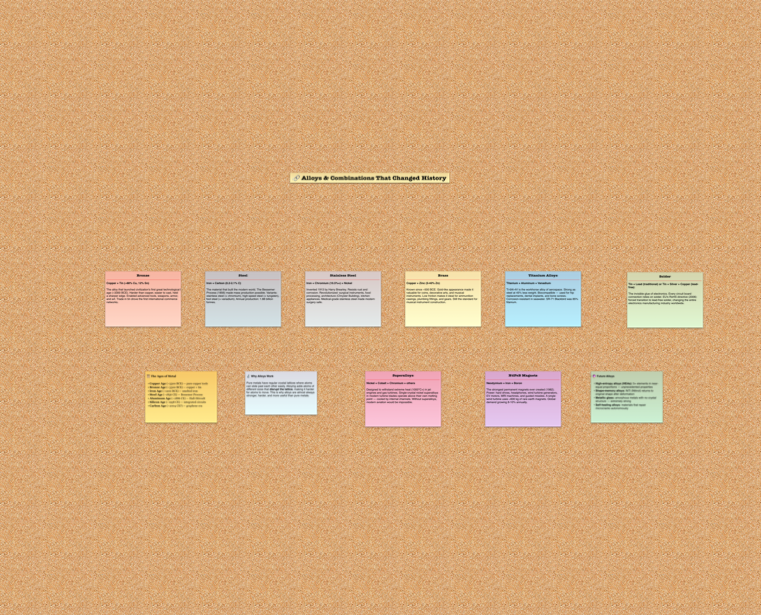
🔗 Alloys & Combinations Deep Dive
Pt — Platinum (78)
Discovery: Antonio de Ulloa, 1735 in South America. Name means "little silver."
World-Changing Impact:
Key Fact: All platinum ever mined would fit in a room ~7.6 meters on each side.
World-Changing Impact:
- Catalytic converters in vehicles — platinum catalyzes exhaust cleanup, reducing air pollution by ~90%
- Cancer treatment: cisplatin chemotherapy drug has saved millions of lives since 1978
- Fuel cell catalysts for hydrogen energy
- Laboratory equipment: platinum crucibles withstand extreme conditions
- Jewelry and investment — rarer than gold
Key Fact: All platinum ever mined would fit in a room ~7.6 meters on each side.
☠️ Toxic Legacy
Lead and mercury are cautionary tales of elements that seemed miraculous but caused immense harm:
The lesson: useful ≠ safe.
Lead and mercury are cautionary tales of elements that seemed miraculous but caused immense harm:
- Leaded gasoline: used 1923-2021 (banned for US cars in 1996), poisoned billions
- Lead paint: banned in US in 1978
- Mercury thermometers: phased out 2000s
- Flint, Michigan water crisis (2014): lead pipes
The lesson: useful ≠ safe.
☀️ Nuclear Fusion
Fusing hydrogen isotopes (deuterium + tritium) could provide virtually unlimited clean energy. NIF achieved ignition in 2022. ITER (France) plans deuterium-tritium fusion from 2039. If achieved, it would be the most transformative energy breakthrough in history.
Future Energy
"The nitrogen in our DNA, the calcium in our teeth, the iron in our blood, the carbon in our apple pies were made in the interiors of collapsing stars. We are made of starstuff."
— Carl Sagan, Cosmos (1980)
— Carl Sagan, Cosmos (1980)